Rooms
Small Living Room Ideas That Actually Work
July 12, 2026 · 9 min read
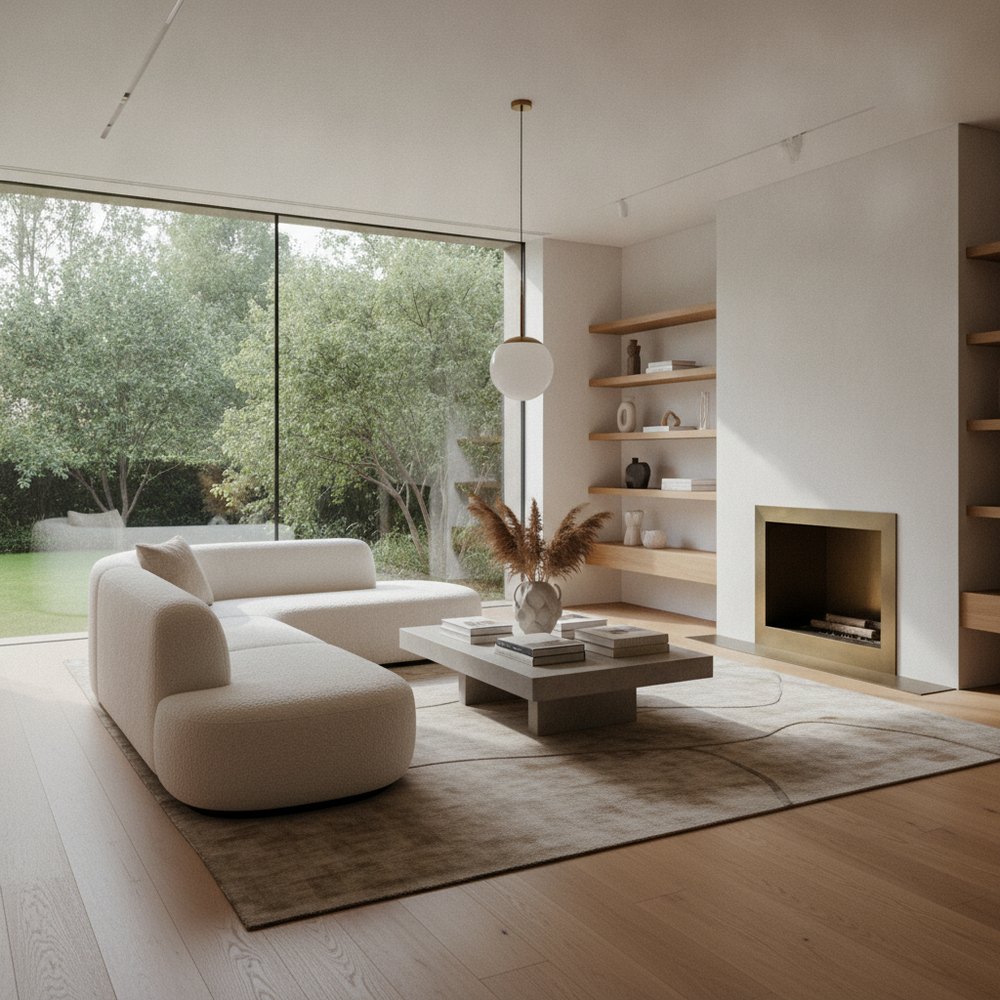
To make a small living room feel bigger, choose fewer, right-scale pieces on visible legs, float them off the walls just enough to create breathing space, keep the palette light and tonal, add one large mirror opposite the window, and hide clutter in dual-purpose storage. Preview the layout with AI before you buy.
Why do small living rooms feel cramped?
A small living room rarely feels tight because of its square footage alone — it feels tight because of how the space is filled. Oversized furniture, too many separate pieces, dark unbroken walls and visual clutter all shrink a room by breaking it into busy fragments the eye has to work through. The floor and the sightlines disappear, and the brain reads 'full' as 'small'.
The fix is not to own less that you love, but to make the room read as calm and continuous. Every decision below works toward the same goal: more visible floor, longer sightlines, more reflected light and fewer competing objects. Get those right and a genuinely compact room can feel generous.
How should you lay out a small living room?
Layout is the single biggest lever. Start by identifying the room's natural focal point — usually a window, a fireplace or the television — and arrange seating to face it rather than scattering pieces around the edges. Counter-intuitively, pushing every item flat against the walls tends to make a small room feel smaller and more like a waiting area; pulling seating in by even a few centimetres creates deliberate breathing space around it.
Keep clear walking routes of at least 60–75cm so the room never feels like an obstacle course. In very tight rooms, a single well-placed sofa plus one or two light chairs beats a bulky three-piece suite. Think about the diagonal, too — the longest sightline in any room is corner to corner, so keep that line open and the space instantly reads larger.
- Anchor to a focal point — face seating toward the window, fireplace or TV, not the walls.
- Protect the walkways — leave 60–75cm of clear circulation so movement feels effortless.
- Float, don't shove — a few centimetres between the sofa back and the wall adds perceived depth.
- Use the corners — an L-shaped or corner sofa can seat more in less linear space.
- Keep the diagonal open — the longest sightline should be unobstructed.
What size furniture works in a small room?
Scale is where most small rooms go wrong. A deep, high-backed sofa that would look right in a large lounge swallows a compact one. Choose furniture with a slim profile, a lower back and — crucially — raised legs. Pieces that stand on visible legs let light and floor flow underneath, so the eye reads more open space and the furniture appears to hover rather than block.
Prefer a few multipurpose pieces over many single-use ones. A nest of tables tucks away when unused; a slim console doubles as a desk; a compact two-seater plus a pair of light armchairs is far more flexible than one dominating sofa. Glass, acrylic and open-frame tables almost disappear, which is exactly what you want from a coffee table in a tight room.
- Legs over skirts — exposed-leg sofas, chairs and units reveal floor and feel lighter.
- Slim and low-backed — a shallower seat depth reclaims valuable centimetres.
- See-through surfaces — glass or acrylic coffee and side tables read as barely there.
- Multipurpose first — nesting tables, storage ottomans and console-desks earn their footprint.
- Round off corners — a round or oval coffee table eases circulation in a tight layout.
Which colours make a small living room look bigger?
Light, tonal palettes expand a room because they reflect more daylight and reduce the visual boundaries between surfaces. Painting the walls, skirting, ceiling and even joinery in closely related soft tones — warm whites, pale greige, soft stone — blurs the edges of the room so the eye can't easily measure it. High contrast does the opposite: a dark skirting against pale walls draws a hard line that says 'the room ends here'.
That doesn't mean beige-on-beige forever. You can absolutely use colour and depth — just carry a single tone up the walls and onto the woodwork, and add richness through texture and a few considered accents rather than lots of contrasting blocks. If you want to understand why each shade changes the mood and perceived size of a space, our guide to wall colour psychology breaks it down. A minimalist or Scandinavian palette is a reliable starting point for small rooms.
- Tone-on-tone walls and trim — one soft colour across walls, skirting and ceiling erases hard edges.
- Light, warm neutrals — warm white, greige and pale stone bounce daylight around the room.
- Add depth with texture — bouclé, linen and wood give interest without visual clutter.
- Limit contrast — save bold contrast for one small accent, not the whole scheme.
- Match large items to the walls — a sofa close to the wall colour recedes instead of dominating.
How do mirrors and light open up a space?
Light is what makes a room feel airy, and a small living room needs every scrap of it. Keep window treatments minimal — a slim blind or light, floor-to-ceiling curtains hung wide of the frame — so nothing eats into the glass. Hanging curtains higher and wider than the window makes the whole wall, and the room, feel taller and broader.
One large mirror is the classic small-room multiplier, and it works best positioned to reflect the window or the brightest part of the room, effectively giving you a second source of daylight and doubling the apparent depth. Then layer artificial light so the room never relies on a single overhead fitting — a central pendant plus a floor lamp and a table lamp create the pools of warm light that make a small space feel cosy rather than boxed in. Our best lighting for every room guide covers layering in detail.
- One big mirror, well placed — reflect the window to borrow its light and depth.
- Maximise the glass — slim blinds or curtains hung wide keep windows unobstructed.
- Hang curtains high and wide — it stretches the wall and lifts the ceiling line.
- Layer three light sources — overhead, floor and table lamps beat one harsh ceiling light.
- Choose warm white bulbs — around 2700K keeps the room inviting after dark.
Where does the storage go?
Clutter is the enemy of small-room calm, so storage has to be built into the furniture rather than added as extra bulk. A storage ottoman hides blankets and doubles as a footstool or occasional seat; a lift-top coffee table swallows remotes and clutter; and a slim sideboard keeps surfaces clear. The principle is that every large item should ideally do two jobs — seat and store, display and conceal.
Go vertical to keep the floor clear. Floating shelves and tall, narrow bookcases draw the eye upward and use wall height that would otherwise be wasted, while keeping the floor — the surface that signals 'space' — as open as possible. Keep about a third of any shelf empty; styling to the brim just recreates clutter on a higher plane.
- Dual-purpose seating — storage ottomans and benches hide what the room can't display.
- Go tall and narrow — full-height shelving uses air, not floor.
- Float it — wall-mounted units and shelves keep the floor visible and open.
- Leave breathing room — style shelves to roughly two-thirds full, no more.
- One home for everything — a single sideboard or media unit corrals the daily clutter.
How can you preview a small living room with AI first?
Small rooms punish mistakes — an over-scaled sofa or the wrong wall colour is expensive and awkward to undo. That is exactly why previewing changes on a photo of your actual room, before you buy or paint, is so useful. AI interior design lets you see a realistic redesign of your space with the layout, walls and windows preserved, so you are judging real options rather than imagining them.
With Decorly, you photograph the room, choose a direction — say light Scandinavian or airy minimalist — and generate several versions to compare. Test a lighter wall colour, a slimmer sofa, a different layout and added shelving one change at a time, then take the version you keep returning to as your shopping brief.
- 1Photograph in daylight — stand in the doorway to capture the whole room and its light.
- 2Upload to [Decorly](/) and pick a style — start light and airy for a small space.
- 3Change one thing at a time — wall colour, then sofa scale, then storage, so you see each effect.
- 4Shortlist and shop — take the winning render to the shop as a clear reference.
Frequently asked questions
How do I make my small living room look bigger?
Use light, tone-on-tone colours, choose slim furniture on visible legs, float seating slightly off the walls, add one large mirror opposite the window, keep the floor clear with vertical storage, and layer warm lighting. Previewing the layout with AI first helps you avoid over-scaled buys.
What colour is best for a small living room?
Light, warm neutrals — warm white, pale greige and soft stone — reflect the most daylight and blur the room's edges. Carrying one tone across walls, skirting and ceiling makes the space feel larger than using high-contrast trim.
Where should the sofa go in a small living room?
Face it toward the room's focal point (window, fireplace or TV) rather than pushing everything against the walls. In very tight rooms a compact two-seater or a corner sofa, floated a few centimetres off the wall, keeps sightlines open and circulation clear.
How do I add storage to a small living room without clutter?
Build storage into furniture — storage ottomans, lift-top coffee tables and a slim sideboard — and go vertical with tall, narrow shelving so the floor stays clear. Keep shelves about two-thirds full to avoid recreating clutter on display.
Do mirrors really make a small room look bigger?
Yes. A single large mirror positioned to reflect the window borrows daylight and doubles the apparent depth of the room. It is one of the most effective, lowest-cost changes you can make in a small living room.