Rooms
AI Living Room Design: Test Layouts and Palettes Before You Buy
September 6, 2026 · 9 min read
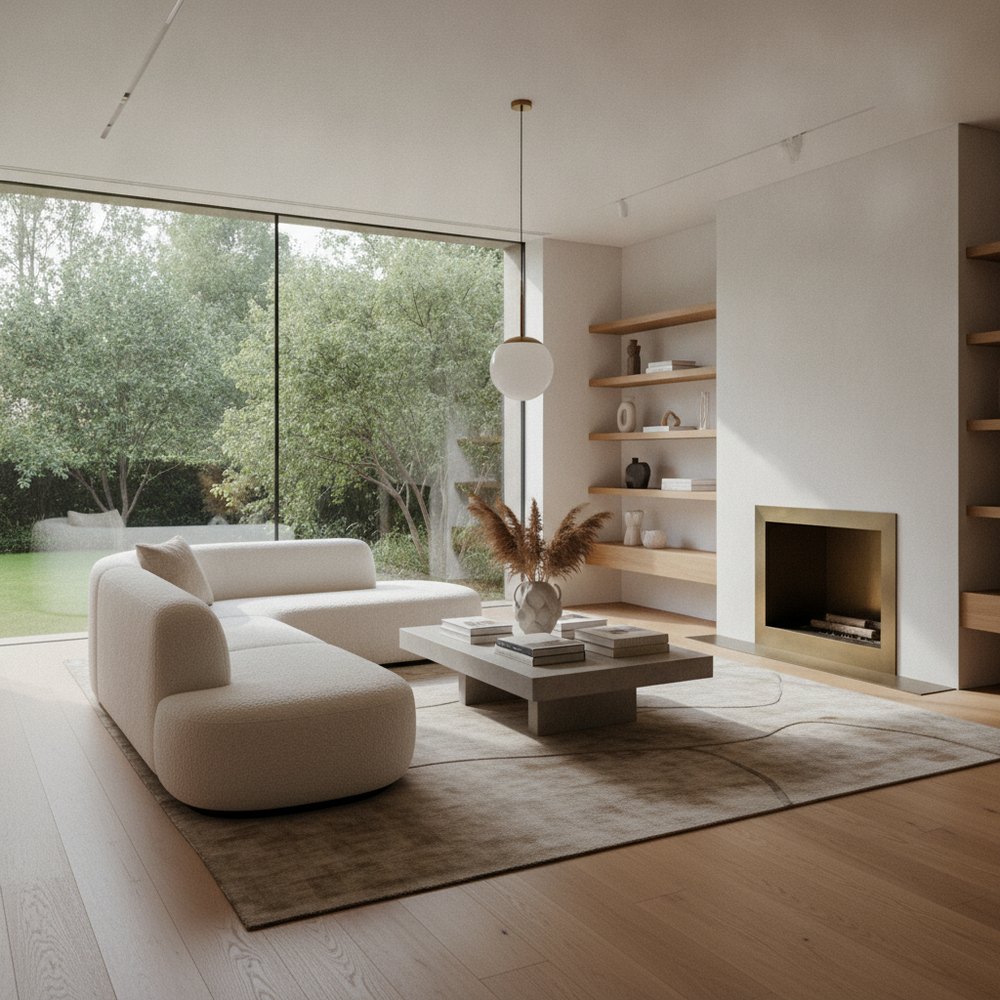
AI living room design lets you photograph your lounge and test sofa scale, layout, palette and lighting on the real room before you spend anything. Because the walls, windows and camera angle stay fixed, you are comparing genuine options for your space rather than looking at inspiration photos.
Why the living room punishes guesswork
Every room can be got wrong, but the living room is the one where mistakes are largest and least reversible.
The sofa is usually the single biggest purchase in the house, it is the hardest thing to return, and its scale determines everything else: how the rug reads, whether you can walk past it, where the light needs to be. Get it 20cm too deep and a room that measured fine on paper becomes one you edge around for a decade. Meanwhile the room is doing more jobs than any other, television, conversation, guests, occasionally work, so a layout that looks elegant can fail functionally within a week.
That combination, high cost and high complexity, is exactly why testing it visually first pays for itself.
How do you test sofa scale properly?
This is the highest-value thing you can do with an AI design tool, and most people skip straight past it to colour.
Take one photo of the room from the corner and run the same scheme with three different seating configurations: a large L-shaped sectional, a three-seater with two armchairs, and a two-seater with a chaise. Keep the paint and flooring identical across all three. What you are looking at is not which is prettiest, it is how much floor is left. The sectional will almost always look luxurious and will almost always eat the route through the room.
Then do the same with depth. A deep, low, lounge-style sofa and a shallower upright one read completely differently in a small room, and the difference is far more obvious rendered in your space than described in a product listing.
Layout questions worth asking the AI
Give it real problems rather than style prompts and the output becomes much more useful.
- "Float the sofa off the wall" to see whether your room is actually big enough for the layout everyone recommends.
- "Face the seating away from the television" if you want to know whether a conversation-first arrangement is liveable in your space.
- "Two seating zones" for a long or open-plan room, which is usually the answer to a room that feels like a corridor.
- "Fireplace as the focal point, television off-centre" if you are fighting the classic two-focal-point problem.
- "Symmetrical" versus "asymmetrical" as two runs of the same room, which tells you more about your own taste than any quiz.
Palette testing in a room with real light
Living rooms tend to be the largest room and often the one with the most complicated light: a big window at one end, dark corners at the other, and completely different behaviour morning versus evening.
That is why testing colour on your own photograph matters more here than anywhere else. A warm white that looks impeccable in a south-facing room can go faintly grey and institutional in a north-facing one. Rather than trusting a swatch, run three candidates on your actual walls and look specifically at the corner furthest from the window. That corner is where paint colours go to die.
If colour is the main thing you are solving, read how to mix colours alongside the renders, because AI will happily give you a palette that is technically pleasant and has no anchor.
Solving the television problem
Almost every living room brief eventually collides with the television, and it is a genuinely hard design problem rather than a matter of taste.
The three viable answers are: make it the focal point and design around it honestly; absorb it into joinery or a dark wall so it disappears when off; or place it off the main axis so the seating faces something else. All three are testable. Run your room with the television above the fireplace, then on a dark-painted wall with shelving either side, then in a corner unit, and the right answer for your proportions usually becomes obvious within three images.
Our guide to decorating around a TV goes through the execution details once you have picked an approach.
Rugs, and why they are usually the mistake
If a living room feels unsettled and you cannot say why, it is the rug, and it is nearly always too small.
The failure mode is a rug that floats in the middle of the floor with all the furniture standing off it, which visually chops the room into pieces. The fix is a rug large enough that at least the front legs of every seat sit on it. This is very easy to test and very hard to imagine, which makes it ideal for AI: generate the same room with a small rug, a room-sized rug, and no rug at all. The difference in how settled the room looks is usually startling.
Sizing details are in our guide to choosing a rug.
Getting a usable brief out of the images
Once you have six or eight generations you like, the job is to extract the decisions rather than admire the pictures.
- Seating footprint, written as a shape and rough dimensions, not a product.
- Rug size, which follows from the seating footprint.
- Wall colour, plus the finish you want on the woodwork.
- Three light sources minimum, and where each one sits.
- One material anchor, oak, brass, black metal, that everything else is chosen to match.
Try it on your own living room
Photograph the room from the corner that shows the most floor, in daylight, with the lights off and the floor clear.
With Decorly you can then run layout, palette and lighting variations of your actual living room in seconds, keeping your window, ceiling and proportions fixed, which is what makes the comparison worth anything. For more starting points, see living room design ideas and small living room ideas.
Frequently asked questions
Can AI show me what a different sofa would look like in my living room?
Yes, and it is the most valuable way to use it. Run the same photo with a sectional, a three-seater plus armchairs and a smaller two-seater, keeping paint and flooring identical, then judge how much clear floor is left in each. Scale problems show up immediately.
Can AI plan my living room layout?
It can show you how specific layouts look and feel in your real proportions, which is usually enough to choose between them. It is not a measured floor-plan tool, so confirm walking routes and clearances with a tape measure before ordering furniture.
How do I test paint colours for a living room with AI?
Generate three candidates on your own photo and look hardest at the corner furthest from the window, not the wall beside it. That is where a colour reveals whether it holds up in low light, which is what usually kills a shade that looked perfect on a swatch.
What size rug does a living room need?
Large enough that at least the front legs of every piece of seating sit on it. A rug floating in the middle of the floor with all the furniture off it is the single most common reason a living room feels unsettled, and it is easy to compare with AI before you buy.