Styles
Zen Interior Design: How to Make a Room Genuinely Calm
August 2, 2026 · 8 min read
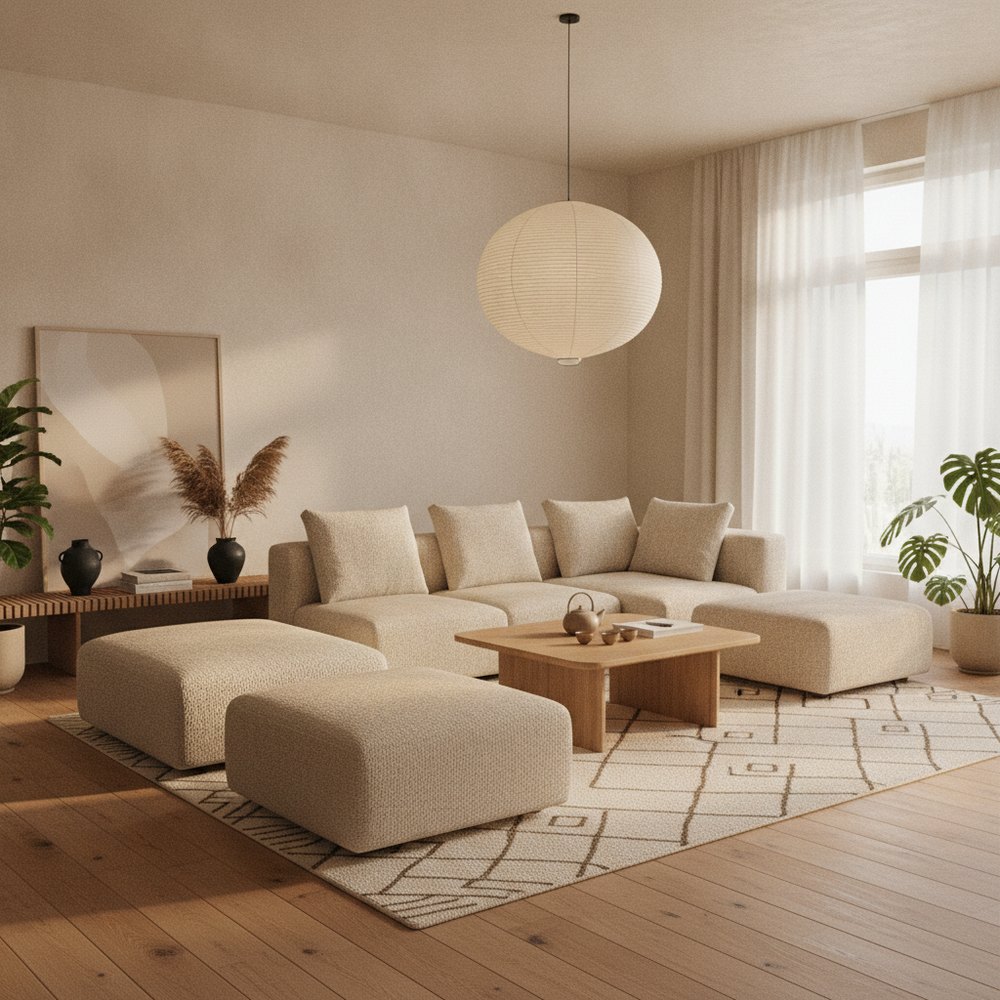
Zen interiors are calm because they reduce visual noise: a narrow palette of natural materials, low furniture that keeps sightlines long, generous empty surfaces, hidden storage, and soft indirect light. It is about how much your eye has to process, not about how few possessions you own.
Calm is a function of visual noise
The reason some rooms feel calm and others do not has less to do with how much is in them than with how much information they present.
Every colour change, every hard edge, every reflective surface, every visible object, every pattern, is something your eye has to process. A room with twenty objects in three colours and one material can feel calmer than a room with eight objects in eight colours and six materials.
This is a more useful framing than minimalism, because it does not require you to own less. It requires you to reduce the number of distinct things your eye registers, which is often a question of storage and coherence rather than of discarding.
The material palette
Few materials, all natural, all matt.
- Timber, warm and matt rather than glossy, ideally one species repeated throughout rather than three.
- Paper and linen, in shades, blinds and upholstery, which soften and diffuse light.
- Stone and plaster, matt and slightly textured, for grounding.
- Rush, tatami and woven natural fibre, on floors and seating, which add texture without pattern.
- No high gloss, no chrome, minimal glass. Reflective surfaces multiply the visual information in a room.
Low furniture and long sightlines
One of the most characteristic and least understood elements of the style.
Traditional Japanese interiors sit low: floor cushions, low tables, low beds, low storage. The functional effect in a modern room is that the wall above the furniture is left open, so sightlines run uninterrupted across the room and the ceiling reads as higher.
You do not need to sit on the floor to use this. A low sofa, a low bed frame, low sideboards rather than tall cabinets, and keeping the upper half of the walls largely clear achieves the same thing.
The corollary is to keep the floor plane as clear as possible. Wall-hung storage, legs on furniture so floor runs underneath, and nothing on the floor that does not need to be there.
The role of empty space
In this style, empty surfaces are not unfinished; they are the point.
The Japanese concept of ma, the meaningful interval, describes the idea that the space between things is as significant as the things themselves. Practically, that means leaving whole surfaces bare: a sideboard with one object on it rather than five, a wall with nothing on it, a corner left empty.
This is genuinely hard to do, because there is a strong instinct to fill. The test is to remove things rather than add them: take everything off a surface, then put back only what you actively want to look at. Most people put back two of the eight items.
Light, soft and indirect
Hard light creates hard shadows and high contrast, which is the opposite of calm.
Zen lighting is diffused: paper shades, fabric shades, light bounced off a ceiling or wall, and daylight filtered through linen or a screen rather than coming in raw. Avoid bare bulbs, downlights that create pools and hard edges, and any single bright source.
Keep it warm, around 2700K, keep the number of sources moderate, three or four, and put them low. A room lit by two low warm lamps and a shaded pendant reads as calm; the same room under four ceiling downlights does not.
Storage is the practical foundation
Nothing else on this list matters if there is visible clutter, and clutter is a storage problem rather than a discipline problem.
The rule is that everything has a closed home. Built-in storage flush with the wall, painted the wall colour, is ideal, since it disappears entirely. Failing that, closed cabinets rather than open shelving, boxes and baskets within any open shelving, and drawers rather than surfaces.
Aim for around 20 per cent spare capacity in your storage. A storage system that is completely full immediately starts overflowing onto surfaces, which is where visual noise comes from.
Zen, Japandi and minimalism
Three overlapping terms and worth distinguishing.
Minimalism is about reduction as an aesthetic end: fewer things, harder edges, often cooler and more architectural. It can be calm or it can be austere.
Zen is about calm as the goal, using natural materials and warmth to get there. It tolerates more objects than minimalism does, provided they are coherent.
Japandi is the hybrid of Japanese and Scandinavian, which in practice means zen principles with Scandinavian furniture and a bit more colour and comfort. Our Japandi guide covers it, and for the harder-edged version see minimalist home design.
See the reduction
The difficulty with calm rooms is that the change is subtractive, which is much harder to picture than an addition.
With Decorly you can photograph your room and see it with a narrowed palette, lower furniture and clear surfaces before you start moving anything. For related styles, see Japandi style and wabi-sabi interior design.
Frequently asked questions
What is zen interior design?
A style aimed at calm through reducing visual noise: a narrow palette of natural matt materials, low furniture that keeps sightlines long, generous empty surfaces, closed storage and soft indirect light. It is about how much your eye has to process, not about owning less.
Why do some rooms feel calmer than others?
Because they present less visual information. Every colour change, hard edge, reflective surface and visible object is something the eye processes. A room with twenty objects in three colours and one material can feel calmer than one with eight objects in eight colours and six materials.
Why is low furniture used in zen interiors?
It leaves the wall above open, so sightlines run uninterrupted and the ceiling reads as higher. You do not need floor seating to use the principle: a low sofa, a low bed, low sideboards rather than tall cabinets, and clear upper walls achieve the same effect.
What is the difference between zen and Japandi?
Zen is the underlying principle of calm through natural materials, low furniture and empty space. Japandi is the Japanese and Scandinavian hybrid: the same principles with Scandinavian furniture, slightly more colour and more built-in comfort.