Guides
How to Choose Tiles for Any Room in Your Home
July 28, 2026 · 9 min read
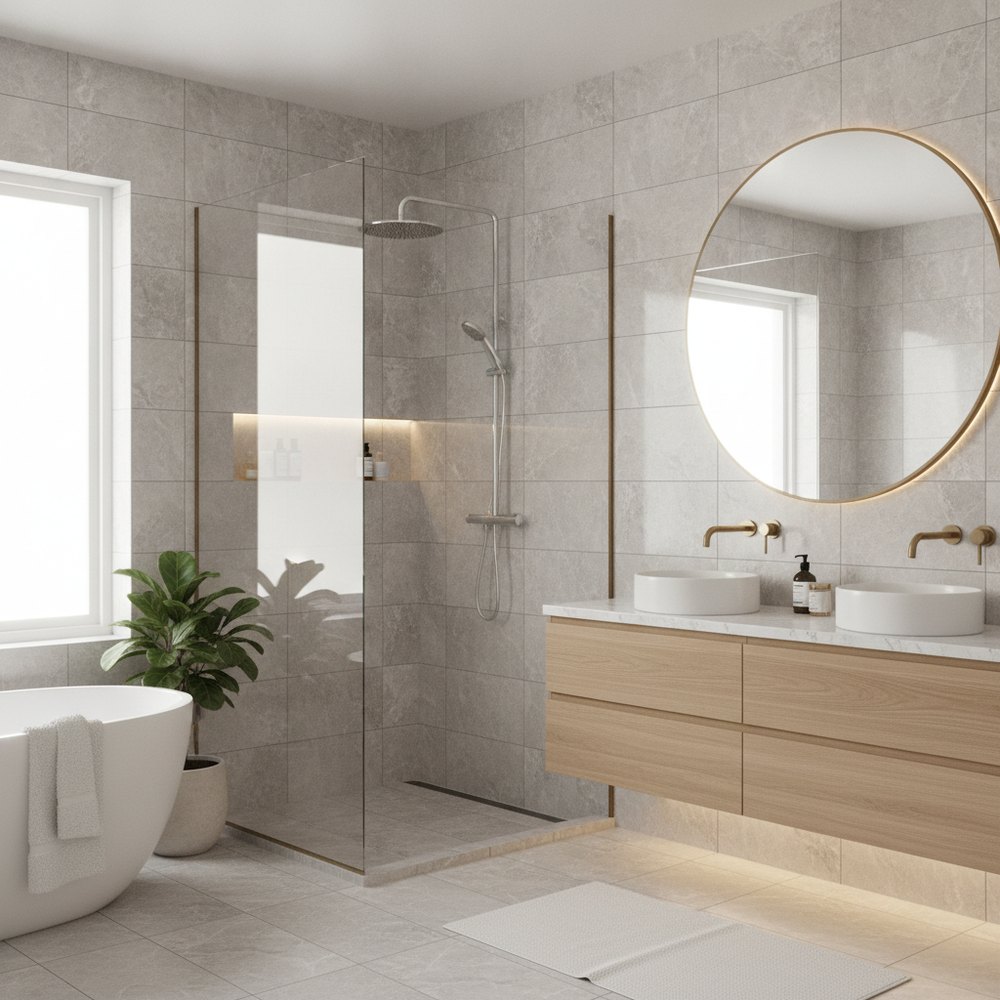
Choose porcelain for floors and wet areas because it absorbs almost no water and wears hard, and ceramic for walls where it is cheaper and easier to cut. Match the finish to the room: matt or textured with an R10 rating or above on any floor that gets wet, and save polished finishes for walls.
Porcelain or ceramic?
The most common question and the answer is mostly about water and wear.
Porcelain is fired at a higher temperature from finer clay, which makes it denser, harder and almost non-porous, typically under 0.5 per cent water absorption. That means it survives freezing, heavy traffic and constant wetting. Through-body porcelain has the same colour all the way through, so a chip does not show a different colour underneath.
Ceramic is softer, more porous and considerably easier to cut, which makes it cheaper to buy and cheaper to fit. It is perfectly good on walls and in low-traffic dry areas, and it is not suitable outdoors or on a busy floor.
The practical rule: porcelain on any floor, and anywhere outdoors or continuously wet. Ceramic on walls where budget matters. Both on a bathroom wall is fine.
The slip rating you actually need
The specification most often ignored and the one with genuine safety consequences.
- R9 is for dry internal areas only. Not a bathroom floor.
- R10 is the minimum for a domestic bathroom floor, kitchen floor or utility.
- R11 for a wet room, a walk-in shower floor, or an entrance that gets rained on.
- R12 and above for external paving and commercial wet areas.
- Check for a barefoot rating too (A, B, C) in bathrooms, since the R scale is measured with shoes on. Class B is the useful bathroom minimum.
Size and format
Format changes how a room reads more than colour does, and there are competing considerations.
Large formats, 600 x 600mm and above, mean fewer grout lines, which makes a room look calmer and larger and reduces cleaning. The requirement is a very flat substrate: a large tile on an uneven floor will rock, crack or show lippage at the edges. Budget for levelling compound.
Small formats and mosaics have more grout, which means more grip, so they are correct on shower floors, and they accommodate falls and curves that a large tile cannot. They also cost more to fit.
Rectangular formats have a direction: laying long tiles along a room's length stretches it, across it widens it. Standard advice is to lay planks in the direction of the longest wall or towards the main light source.
Finish: matt, polished, textured, lappato
Finish affects safety, cleaning and how the tile looks under your lighting.
Matt is the safest all-round choice: good grip, hides water marks and footprints, and reads as more expensive in most contemporary schemes. It can be slightly harder to clean if heavily textured.
Polished is highly reflective, bounces light around a room, and is genuinely slippery when wet. It also shows every smear. Use it on walls, or on dry floors where you accept the maintenance.
Textured and structured finishes give the highest grip and are right outdoors and in wet rooms. Lappato, a semi-polished finish, sits between matt and polished and is a reasonable compromise for a floor where you want some sheen.
Under-cabinet or raking light will exaggerate texture, which is worth remembering if you are choosing a handmade or structured tile.
Buying: quantities, batches and cuts
The logistics that cause most tiling problems.
Order 10 per cent extra for a straightforward layout and 15 per cent for a diagonal, herringbone or heavily cut room. You will need spares later, and matching a batch in two years is usually impossible.
Check the batch number on every box on delivery. Tiles from different batches vary in shade, and a tiler who mixes them will produce a visibly patchy floor. Some tiles are also supplied with an intentional shade variation rating, V1 to V4, where V4 means substantial variation between tiles; that is a design feature but you should know before you open the boxes.
Ask your tiler to dry-lay a square metre before fixing, particularly with any tile that has variation, so you can see the mix.
Grout and trim, which are half the look
People choose tiles carefully and grout by default, and grout is roughly 5 per cent of the surface and 50 per cent of the impression.
Matching grout makes tiles read as one continuous plane, which is what you want with large formats and in small rooms. Contrasting grout turns the tile into a pattern, which is a deliberate graphic choice.
Use epoxy grout in showers and anywhere heavily wetted; it costs more, is harder to apply and resists staining and mould far better than cement grout. Never use white grout on a floor.
For edges, a tile trim in a matching or deliberately contrasting metal gives a crisp finish. The alternative, a mitred edge where two tiles are cut at 45 degrees and joined, is more expensive, looks considerably better, and requires a good tiler.
Where to use what
A quick summary by room.
Bathroom floor: porcelain, matt, R10 minimum, mid-tone grout. Shower floor: small format or mosaic, R11. Bathroom walls: anything, ceramic is fine, large format for calm.
Kitchen floor: porcelain, matt, R10, and consider a mid-tone that hides crumbs and marks. Splashback: ceramic is fine and cheaper; slab porcelain if you want no grout.
Hallway: porcelain, R10 or R11 at the door where rain comes in, and a dark or mid tone rather than pale.
Outdoors: porcelain rated for external use, R11 or above, and check frost resistance.
See the tile at full scale
A sample tile tells you the colour and nothing about how a whole room of it will feel, which is the actual decision.
With Decorly you can photograph a room and compare formats, finishes and grout colours rendered at full scale in your own space before ordering. For room-specific guidance, see bathroom tile ideas and kitchen backsplash ideas.
Frequently asked questions
Should I use porcelain or ceramic tiles?
Porcelain on any floor and anywhere wet or outdoors, because it is denser, harder and absorbs almost no water. Ceramic is softer, more porous and cheaper to buy and fit, which makes it fine for walls and low-traffic dry areas but not for busy floors or outside.
What slip rating do I need for floor tiles?
R10 is the minimum for a domestic bathroom, kitchen or utility floor. R11 for a wet room, walk-in shower floor or rained-on entrance, and R12 or above for external paving. In bathrooms also check the barefoot rating, where class B is the useful minimum.
How many extra tiles should I order?
10 per cent extra for a straightforward layout and 15 per cent for diagonal, herringbone or heavily cut rooms. You will need spares later, and matching a batch after a couple of years is usually impossible, so buy them now.
Does grout colour really matter?
Substantially. Grout is around 5 per cent of the surface and half the impression. Matching grout makes the tiling read as one continuous plane, contrasting grout turns it into a pattern. Use epoxy grout in showers, and never white grout on a floor.