Rooms
Bathroom Tile Ideas: Choosing Format, Colour and Grout
August 14, 2026 · 9 min read
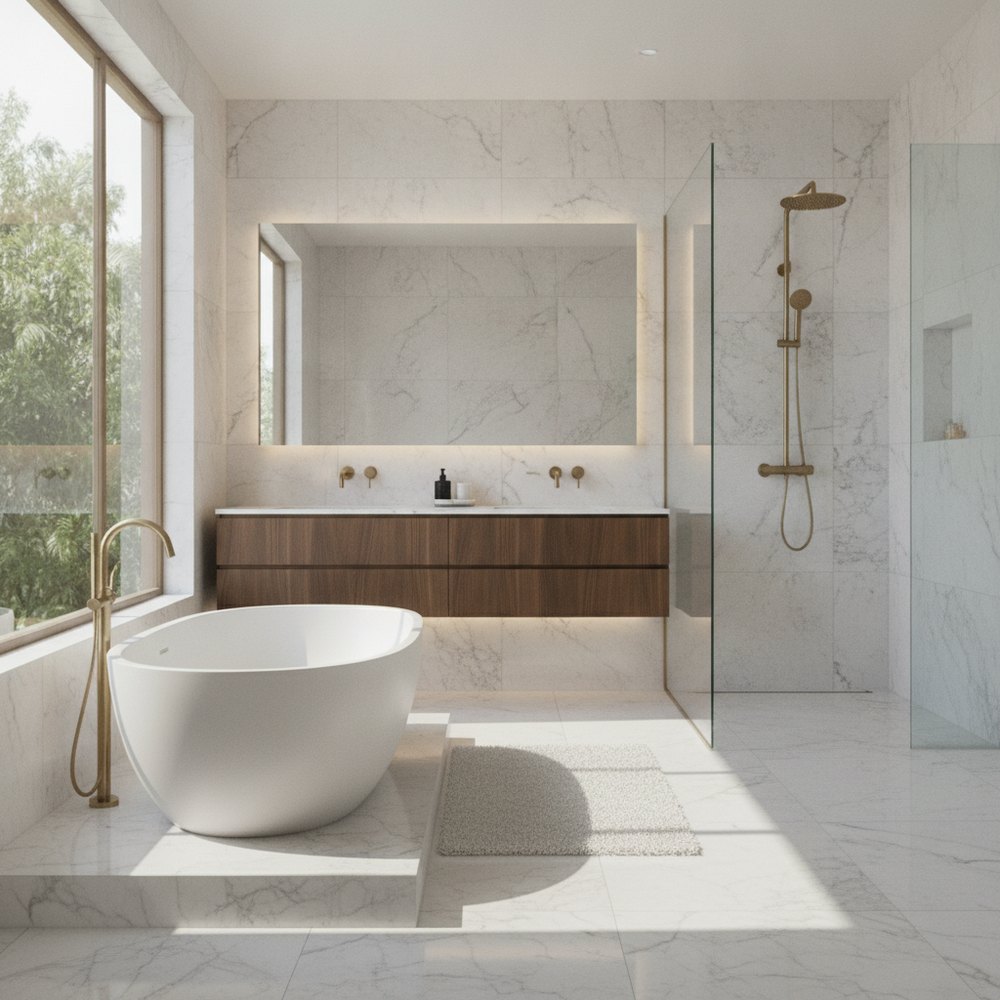
In most bathrooms, large-format tiles with matching grout make the room look bigger and calmer, because fewer grout lines mean fewer things for the eye to count. Use one tile everywhere for a seamless look, or one wall tile plus one contrasting floor tile. Three or more different tiles in a small bathroom almost always looks busy.
Format matters more than colour
People agonise over tile colour and choose the format almost by accident, which is the wrong way round.
The reason is grout. A wall covered in 100 x 200mm metro tiles has an enormous amount of grout line, and every one of those lines is a visual interruption your eye registers. The same wall in 600 x 1200mm slabs has perhaps three joints. In a small bathroom, that difference does more to change how large the room feels than any colour decision.
This is why the current preference for large-format tiles is not just fashion. It genuinely calms a small hard-surfaced room, and it also means less grout to clean, which matters more than aesthetics after two years.
Grout colour is a design decision
Treat grout as a material choice rather than an afterthought and a lot of tile decisions become easier.
- Matching grout makes the tiled surface read as one continuous plane. This is what you want in a small bathroom and behind a large-format tile.
- Contrasting grout turns the tile into a pattern. Dark grout with white metro tiles is a deliberate graphic look and a completely different room from the same tiles with white grout.
- Mid-grey grout on white floor tiles is the practical compromise, since white floor grout discolours no matter what you do.
- Never use white grout on a floor. This is the single most regretted tiling decision.
- Epoxy grout costs more and is worth it in a shower, where it resists staining and mould far better than cement grout.
Layout patterns and when to use them
The same tile laid four ways gives four different rooms.
Stack bond, tiles aligned in a grid, is the most modern and the least forgiving, because any wall that is out of square is immediately obvious. Brick bond with a half offset is the traditional metro layout and hides small irregularities. A third offset is a softer version and reduces the risk of lippage with long tiles.
Vertical stacking is having a long moment and does something useful: it draws the eye upwards, so it makes a low bathroom feel taller. Herringbone is the most decorative and roughly doubles the labour cost, so use it in one defined area rather than across a whole room.
Whatever the pattern, plan where the cuts land. A tiler who starts from a corner will finish with a 20mm sliver on the visible wall. Setting out from the centre so both ends have equal cuts is the mark of a good job.
How high should you tile?
There are three sensible answers and a lot of bad ones in between.
Full height everywhere gives the most seamless result and the highest cost. It suits a small bathroom where you want one continuous surface.
Full height in the wet zone only, shower and behind the bath, with paint elsewhere, is the value answer and looks entirely deliberate if the tiling stops at a logical line, a corner or a full wall, rather than partway along a wall.
Half height all round, at about 1100 to 1200mm with a tile trim or a timber rail, is the traditional option and suits period homes. It also protects the wall where splashing actually happens.
The one to avoid is tiling to an arbitrary height like 1500mm with nothing above it, which reads as a builder running out of tiles.
Choosing floor tiles
Floor tiles have a job wall tiles do not, which is not being slippery.
Check the slip rating. For a bathroom floor you want an R10 or above, and for a wet room or walk-in shower floor, R11. A polished porcelain that looks superb will be genuinely dangerous wet, and no amount of care fixes it.
Smaller floor tiles in a shower are not just an aesthetic choice: more grout lines mean more grip, and small formats accommodate the fall to the drain. Mosaic on the shower floor with large format on the walls is the standard combination for exactly this reason.
For the rest of the floor, running the same tile as the walls creates a seamless box; a contrasting floor grounds the room. Both work. A third pattern rarely does.
Small bathroom tile strategy
A specific set of choices that consistently make small bathrooms look larger.
- 1One tile, floor to ceiling, all walls, in a light or mid tone with matching grout. The room becomes one continuous surface.
- 2Large format, 600 x 600mm or bigger, to minimise grout lines.
- 3Run the floor tile up into the shower rather than changing material, which keeps the floor plane unbroken.
- 4Skip the border tile. Decorative borders chop a small room horizontally.
- 5Add pattern in one place only, if at all, usually the floor.
The tiles that date fastest
Not a judgement on taste, just an observation about what has aged badly in bathrooms over the last two decades.
Small mosaic strips used as a border at 1200mm. Beige and cream travertine-effect ceramics. High-gloss black and white chequerboard in a small bathroom. Tiles with a printed pebble or leaf motif. And any tile chosen primarily because it was on offer, which is more common than anyone admits.
What ages best is plain, in a natural colour, in a good format: stone-effect porcelain, plain matt ceramics, terrazzo, and honest metro in a classic layout. The pattern goes somewhere small and replaceable.
See the tile at full scale
A 10cm sample tells you almost nothing about how twelve square metres of a tile will feel, which is the single biggest reason people are disappointed by finished bathrooms.
With Decorly you can photograph your bathroom and see different tile formats, colours, grout choices and layouts rendered at full scale in your own room before ordering. For the wider room, see small bathroom ideas and AI bathroom design.
Frequently asked questions
What size tiles make a bathroom look bigger?
Large formats, 600 x 600mm or larger, with matching grout. Fewer grout lines mean fewer visual interruptions, so the wall reads as one continuous plane. Format does more for perceived size in a small bathroom than tile colour does.
What grout colour should I use in a bathroom?
Matching grout for a seamless look, contrasting grout if you want the tile to read as a pattern. Never use white grout on a floor, as it discolours regardless of care; mid-grey is the practical choice. Epoxy grout in the shower resists staining and mould far better than cement.
How high should you tile a bathroom wall?
Three sensible options: full height everywhere for a seamless small bathroom, full height in the wet zones only with paint elsewhere, or half height at 1100 to 1200mm with a trim. Stop at a logical line such as a corner or a full wall, not partway along one.
What slip rating do bathroom floor tiles need?
R10 or above for a bathroom floor, and R11 for a wet room or walk-in shower floor. Polished porcelain that looks excellent dry can be genuinely dangerous wet, so check the rating before falling for a finish.