Outdoor
Garden Landscaping Ideas That Work Year-Round
July 11, 2026 · 8 min read
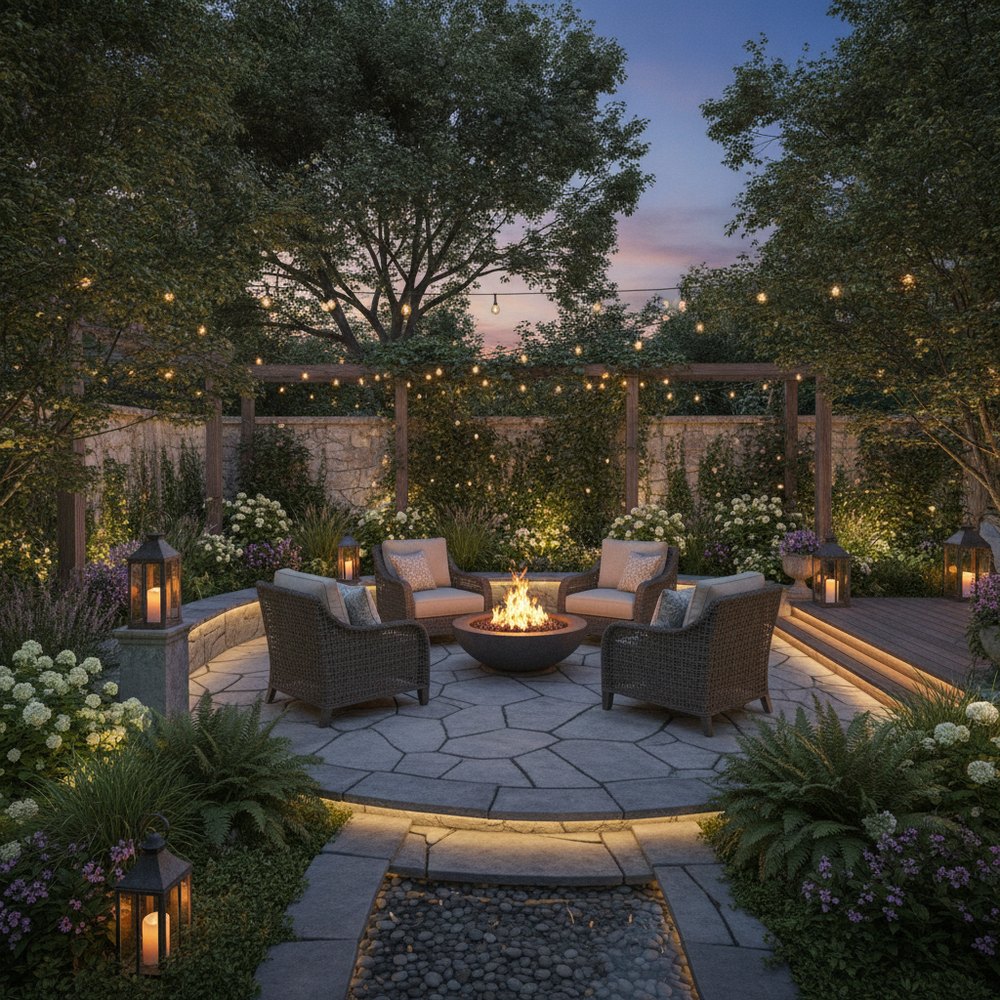
Great garden landscaping starts with structure, not plants: divide the space into zones for sitting, dining, play and growing; balance hard landscaping with planting; build a year-round backbone of evergreens; then layer in lighting and low-maintenance colour. Plan the bones first and the garden looks intentional in every season.
Where should you start with garden landscaping?
Amateur gardens are usually a collection of plants; designed gardens are a plan that the plants fill in. Before buying anything, resolve the layout: how you move through the space, where the sun falls at the times you actually use the garden, and what you want to look at from indoors. The view from your kitchen or living-room window is one of the most-used sightlines in the whole house — design to it.
Sketch the boundaries, mark north, note where the sun sits morning and evening, and flag the ugly bits to screen (a shed, a fence, a neighbour's window) and the good bits to frame (a mature tree, a long view). Everything else follows from that.
How do you divide a garden into zones?
A garden that tries to be one big undivided space usually feels smaller and less useful than one broken into clear zones. Each zone has a job — somewhere to sit in the sun, somewhere to eat, somewhere for children or planting — and the transitions between them create a sense of journey that makes even a small plot feel larger.
- A sitting or lounging zone positioned for the sun at the time you relax.
- A dining zone near the house for easy carrying to and from the kitchen.
- A utility zone for bins, storage, compost and tools, screened from view.
- A growing zone (beds, raised planters or a greenhouse) in the sunniest spot.
- A play or lawn zone if you need open, soft ground.
- Paths and thresholds that link the zones and tell you where to walk.
Hardscape vs planting: getting the balance right
Hardscaping — paving, decking, paths, walls, pergolas — is the garden's skeleton; planting is its flesh. Get the balance wrong in either direction and it shows: all hard surfaces and it feels like a car park; all planting and it feels chaotic and becomes a maintenance burden. A useful starting point for a usable garden is roughly one third hard surface to two thirds soft (planting and lawn), adjusted for how much you actually sit out versus garden.
Invest in hardscaping quality over quantity. It is expensive and permanent, so a smaller area of good paving beats a large area of cheap slabs. Keep materials limited and repeated — one main paving material, one gravel, one timber tone — for the same reason you limit materials on a façade: cohesion. Align paths and paving to the lines of the house so the garden feels connected to the building rather than bolted on.
How do you build year-round structure?
The commonest reason a garden looks great in June and grim in January is that it has no permanent structure. Structure is the set of elements that hold their shape all year: evergreen hedges and shrubs, clipped forms, trees with good bare-branch shape, and the hardscape itself. Get this backbone right and the garden reads as designed even when nothing is flowering.
- Evergreen hedging or clipped shapes to hold the outline in winter.
- At least one small tree for height, shade and structure.
- Repeated evergreen shrubs to anchor beds and corners.
- Hard landscaping and paths that define the layout independent of season.
- A few plants with winter interest — bark, berries, seedheads or scent.
Layered planting: the designer's formula
Designers plant in layers, like a section through woodland, so beds have depth and always have something doing the work. Think in tiers from tall to low, back to front: canopy, structure, the main show, and ground cover to knit it together and suppress weeds.
- 1Canopy layer — small trees for height and dappled shade.
- 2Structural layer — evergreen and larger shrubs that hold the shape.
- 3Perennial layer — the seasonal colour and movement, planted in generous drifts.
- 4Ground-cover layer — low, spreading plants that fill gaps and cut weeding.
Low-maintenance planting that still looks good
Low maintenance is mostly a design decision, not a plant list. The biggest labour savers are right-plant-right-place (choosing plants that suit your soil, sun and climate so they thrive without fussing), generous mulching to lock in moisture and stop weeds, and dense planting so bare soil — where weeds germinate — barely exists.
Two designer habits also make planting look professional: plant in odd-numbered groups (threes, fives, sevens) rather than dotting single plants around, and repeat a small palette of plants along the bed to create rhythm. A calm garden uses fewer species, more times.
- Choose plants suited to your actual conditions rather than fighting them.
- Favour tough, structural perennials, ornamental grasses and evergreen shrubs.
- Mulch beds well each year to suppress weeds and hold moisture.
- Plant densely so ground cover crowds weeds out naturally.
- Reduce fussy lawn edges and awkward mowing strips.
- Group thirsty plants together and add simple drip irrigation if needed.
Garden lighting after dark
Garden lighting doubles the hours you can enjoy the space and transforms the view from indoors at night. Use warm white light (around 2700K) and, as with interiors, layer it rather than relying on one bright source. The magic is in restraint — a few pools of light read as atmospheric; a garden lit like a stadium does not.
- Uplight a tree or a specimen shrub for instant drama.
- Wash a wall or fence to create depth and a backdrop.
- Mark steps, level changes and path edges for safety.
- Add a warm glow to the dining and sitting zones.
- Keep fittings discreet and aim light down or across to avoid glare and light pollution.
Previewing your garden before you dig
Landscaping is one of the slowest, most expensive things to change your mind about once it is built, which makes it the ideal candidate for previewing first. Take a photo of your current garden and test directions — a paved dining terrace, a gravel garden, lush layered borders, a clean contemporary courtyard — before you commit to a design or a quote.
Because Decorly keeps your garden's real shape and proportions, the preview shows your plot restyled rather than a stock garden. It pairs naturally with an exterior refresh — the front garden and façade read as one picture from the street. For the underlying lighting principles, our best lighting for every room guide applies outdoors too.
- 1Photograph the garden in even daylight, capturing the whole space and its boundaries.
- 2Upload it to Decorly and choose a garden style.
- 3Generate several looks and note which zones, materials and planting density you keep preferring.
- 4Use the favourite as a visual brief for a landscaper, or as your own build plan. Explore more garden ideas or the full ideas library to start.
Frequently asked questions
How do I start planning a garden landscape?
Begin with the layout, not the plants. Map sun, sightlines and boundaries, divide the space into zones for sitting, dining, utility and growing, then design the hard landscaping and planting around that structure.
What is the right balance of paving to planting?
For a usable garden, roughly one third hard surface to two thirds soft (planting and lawn) is a sensible starting point, adjusted for how much you sit out versus garden. Prioritise the quality of the hardscaping over its quantity.
How do I keep a garden looking good all year?
Build a permanent backbone of evergreens, clipped shapes, a tree and hard landscaping so the garden holds its structure in winter, then layer seasonal colour in front of it.
What is the easiest way to a low-maintenance garden?
Match plants to your conditions, plant densely and mulch generously. Most garden labour comes from weeding bare soil and fighting plants that were wrong for the spot.
Can I preview a garden design before building it?
Yes. Upload a photo to Decorly, choose a garden style and see a photorealistic redesign of your actual plot in seconds — a low-risk way to test ideas before spending on a landscaper.