Rooms
AI Bathroom Design: Test Tile, Colour and Fittings Before You Commit
September 4, 2026 · 8 min read
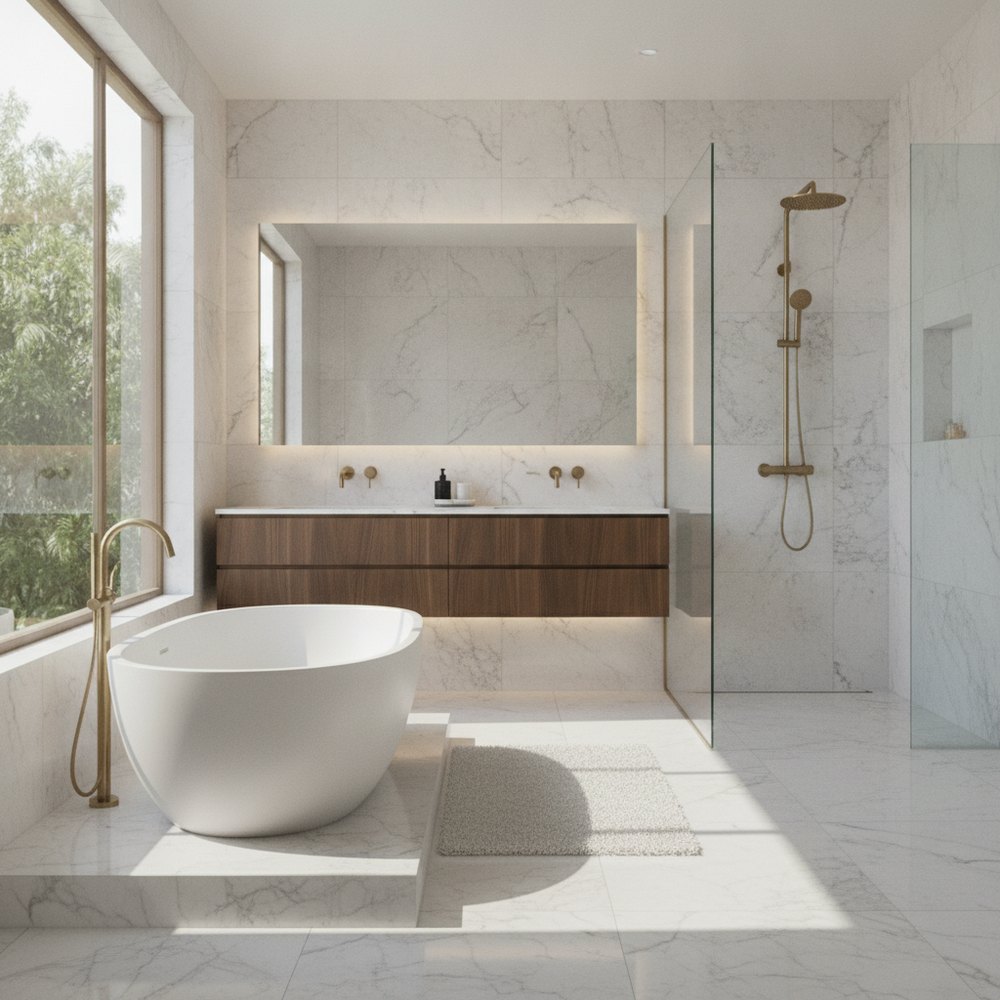
AI bathroom design lets you photograph your bathroom and see it with different tiles, wall colours, vanities, fittings and lighting while the sanitaryware and window stay put. In a room where nearly every surface decision is permanent, seeing it at full scale first removes most of the risk.
Why bathrooms punish small mistakes
A bathroom is the smallest room in the house and the most expensive per square metre, which is an unforgiving combination.
Every surface is a committed decision. Tile is not something you change your mind about on a Saturday. The vanity is plumbed in. The lighting is usually wired into a specific spot. And because the room is small, every one of those surfaces occupies a huge share of what you see, so a tile you were lukewarm about becomes the dominant fact of the room.
It is also a room where samples lie particularly badly. A single 10cm tile tells you almost nothing about how 12 square metres of it will feel, especially when it is wrapped around a small space with hard, reflective surfaces.
The tile decision, tested properly
Tile is the highest-stakes choice in the room, so give it the most generations.
- Format first, colour second. Large-format tiles with fewer grout lines make a small bathroom read as calmer and bigger. Compare a large format against a classic metro in the same colour and the difference is mostly about grout, not shade.
- Grout colour is a genuine design decision, not a detail. The same white metro tile with white grout and with dark grout are two entirely different bathrooms.
- One tile or two. Test a single tile everywhere against a floor tile plus a different wall tile. Single-tile schemes usually feel more expensive.
- Full-height versus half-height. Tiling to the ceiling in a wet zone and painting above changes both cost and feel.
- Pattern in one place. If you want a patterned tile, test it on the floor only, then on one wall only, and see which your eye prefers.
How do you make a small bathroom feel bigger?
The moves that genuinely work in a small bathroom are mostly about reducing visual interruptions, and they are all testable.
Wall-hung fittings are the biggest single lever, because seeing continuous floor underneath the vanity and the WC tricks the eye into reading more space. A frameless or fluted glass screen instead of a shower curtain does the same thing by keeping the sightline unbroken. Large-format tiles reduce grout lines, which reduces the number of things the eye counts. And a large mirror, ideally wall-to-wall above the vanity, does more than any of them.
Run your own bathroom with and without each of these and the cumulative effect across four changes is usually far more dramatic than any single one. Our small bathroom ideas guide covers the practical constraints.
Colour in a room with no natural light
Plenty of bathrooms have no window at all, and the instinct is always to paint them white. It is usually the wrong instinct.
A windowless room painted brilliant white does not read as bright; it reads as a bathroom in a budget hotel, because there is no daylight for the white to bounce. Darker, warmer, more saturated colours often work far better in a windowless bathroom, because they stop pretending and lean into the enclosure. Deep green, oxblood, warm charcoal and even black can turn a boxy internal bathroom into the most characterful room in the flat.
This is precisely the kind of counterintuitive move that nobody believes until they see it rendered in their own room, which makes it one of the best uses of an AI tool.
Fittings: the metal decision
Taps, shower fittings, towel rails, handles and the frame of the shower screen usually want to be one metal, and that single decision sets the entire tone of the room.
Chrome is neutral and disappears. Black is graphic and modern and shows limescale relentlessly in hard-water areas. Brushed brass is warm and softens a cool tiled room. Nickel sits between chrome and brass. Because every one of these appears in six or seven places at once, the effect is much stronger than you expect from a single tap.
Test all four in the same rendered bathroom. It takes minutes and it prevents the classic error of buying a brass tap and a chrome towel rail six weeks apart.
Lighting a bathroom you actually want to use
Most bathrooms have one bright ceiling downlight and a mirror you cannot see your face in properly. Both are fixable and both are worth testing.
The combination that consistently looks best is light at face height beside or around the mirror, plus a soft general light, plus, if there is a bath, something low and warm that lets the room be dim. Compare that against your current single overhead source. The overhead-only version always looks like a utility room; the layered version looks like somewhere you would run a bath.
What to check before you order
The render is a brief, not a specification. Before anything is bought, confirm the practical constraints.
- Clearances in front of the WC and basin, which a render will not verify for you.
- Whether the wall can take a wall-hung vanity or WC frame, which is a structural question.
- Slip rating on any floor tile, which no image will tell you.
- Extraction, because a beautiful bathroom with poor ventilation becomes a mouldy bathroom.
- Electrical zones, which govern where lighting and sockets can legally go.
Try it on your own bathroom
Shoot from the doorway with the light off if there is any daylight, and get the floor plus at least two walls in frame.
With Decorly you can restyle your real bathroom in seconds and compare tiles, colours, fittings and lighting against your own proportions before a single box is ordered. For more direction see small bathroom ideas, luxury bathroom design and bathroom tile ideas.
Frequently asked questions
Can AI design my bathroom from a photo?
Yes. Upload one photo taken from the doorway showing the floor and at least two walls, and the tool restyles the tiles, wall colour, vanity, fittings and lighting while keeping the sanitaryware positions, window and proportions fixed.
What colour should a bathroom with no window be?
Not automatically white. Without daylight, brilliant white reads flat and institutional. Deep, warm, saturated colours, green, oxblood, charcoal, often work far better in a windowless bathroom because they lean into the enclosure rather than fighting it. It is worth rendering both before deciding.
How can I make a small bathroom look bigger?
Wall-hung vanity and WC so the floor runs underneath, large-format tiles to cut down grout lines, a frameless glass screen instead of a curtain, and the largest mirror the wall will take. The four together are far more effective than any one alone.
Does AI bathroom design replace a bathroom fitter?
No. It settles the look, which is the part people find hardest. It cannot verify clearances, slip ratings, electrical zones, extraction or whether a wall will carry a wall-hung frame. Take the render to a fitter as a brief.