Guides
Statement Lighting Ideas That Do Real Work
July 25, 2026 · 8 min read
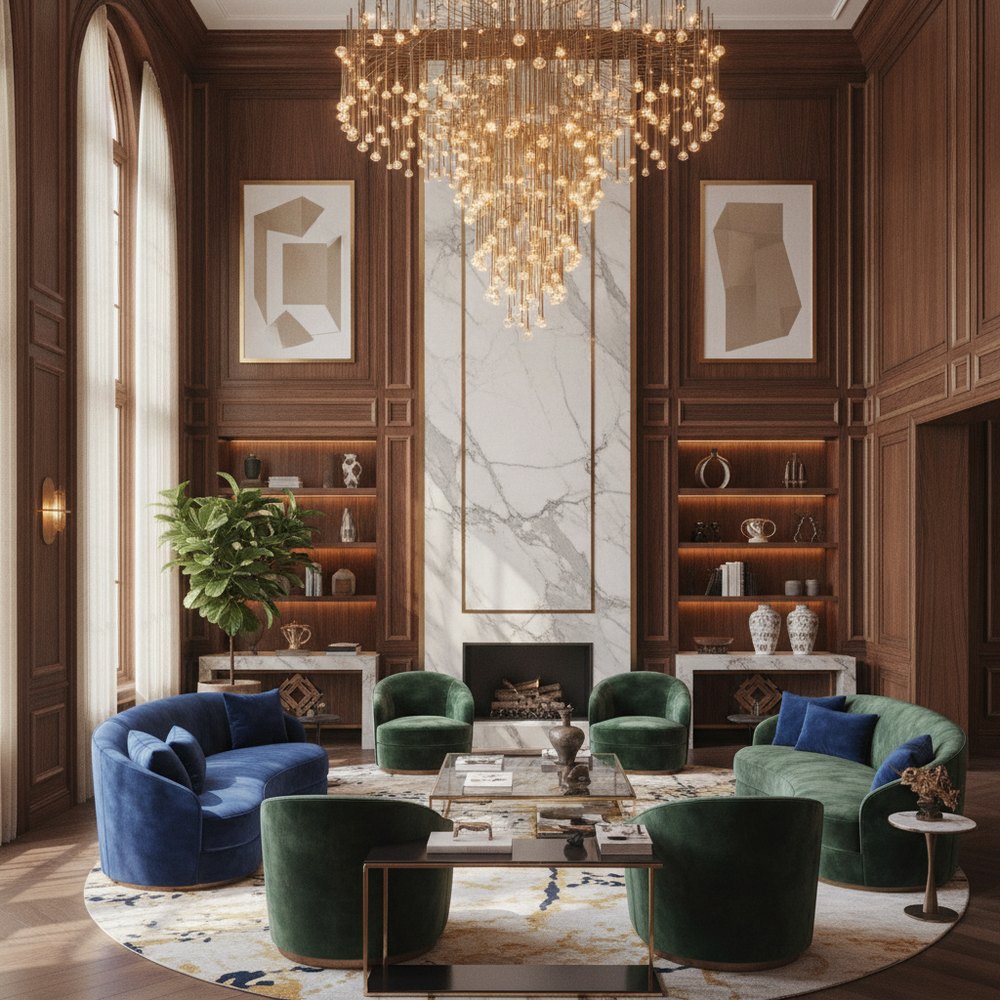
Statement lighting is a fitting chosen to be looked at, not just to light. It earns its place over a dining table, a kitchen island, in a stairwell or an entrance. Hang a pendant roughly 75-90cm above a table surface, go bigger than feels sensible, and always layer softer light around it.
What counts as statement lighting?
A statement light is a fitting that does a second job beyond illumination: it's a piece of sculpture that happens to glow. An oversized pendant, a fixture with an unusual silhouette, a cluster of hand-blown glass, a big paper globe, an armful of brass arms. The point is presence. When you walk in, you notice the light before you notice much else.
That's also why one is usually enough per space. A statement fitting wants a clear stage. Two competing sculptural pieces in one room fight each other and the room loses; one strong piece with quieter supporting light almost always wins.
Where a big light actually earns its keep
Statement lights work hardest where there's a natural focal point begging for one, and fall flat when they're floating in the middle of nowhere. Put them where the architecture already wants your eye to go.
- Over the dining table the classic, and still the best. The table anchors the light and the light anchors the room.
- Above a kitchen island one large piece, or a considered run of two or three, turns a work surface into a centrepiece.
- In a double-height stairwell or hallway a long cascading fitting fills vertical volume that otherwise reads as dead air.
- In an entrance the first thing you see sets the tone for the whole home; a strong fitting here does a lot of work.
- Beside a bed oversized pendants either side free the bedside tables and look far more deliberate than matching lamps.
How high to hang a pendant over a table
This is the number people most often get wrong, and getting it wrong ruins an expensive fitting. Over a dining table, the bottom of the pendant should sit roughly 75-90cm above the tabletop, not the floor. That's low enough to feel intimate and to pool light on the table, high enough that people sitting opposite can see each other and nobody clips their head standing up.
The instinct is always to hang too high, out of nervousness. Resist it. A pendant that floats up near the ceiling looks apologetic and lights nothing useful. If your ceilings are unusually tall, hold the 75-90cm above the table and let the flex run long; the low fitting over the table is exactly the effect you want. Over an island the same range applies, though you can nudge towards the higher end if people work standing at it.
Go bigger than feels sensible
Undersized lighting is the most common fault in a room, and a timid statement light is a contradiction in terms. The fitting you think is slightly too big is usually the right one; the one that felt safe in the showroom will look mean once it's up.
For a dining pendant, a rough guide is a fixture around a third to half the width of the table, so a 90cm-wide table wants something in the region of 45cm across, and often you can push larger. In a big room or a tall stairwell, scale up hard, these spaces swallow fittings whole. When in doubt, size up. Nobody ever walked into a room and thought the statement light was too confident.
Layering: the drama needs a supporting cast
A statement light almost never works as a room's only light source. On its own it's either too bright and harsh or too dim and gloomy, and it flattens everything else. The drama only lands when it sits on top of softer, layered light. This is the bit people skip, and it's why some expensive fittings still make a room feel like a waiting area.
Build the room in layers and let the statement piece be the top note.
- Ambient a soft, general wash, ideally on a dimmer, so the room has a low base level.
- Task light where you actually do things, a reading lamp, under-cabinet strips, a desk light.
- Accent small pools that graze a wall, uplight a plant, or wash over art.
- The statement piece on its own dimmer circuit so you can bring it up for effect and drop it for atmosphere.
Sculptural fittings when the light is off
Here's the test a lot of statement lights fail: they're only interesting lit. But a fitting hangs in your room all day, mostly switched off, so its silhouette in daylight matters as much as its glow at night.
Choose something you'd be happy to have as an object even if it never turned on, a sculptural shape, an interesting material, a form that casts a good shadow. Matte black, aged brass, rattan, plaster, hand-blown glass, all hold their own unlit. Shiny chrome and anything fussy tends to look like a switched-off appliance in daylight. For how this fits into the wider scheme, our best lighting for every room guide covers the full layered approach.
Common statement lighting mistakes
The failures here are consistent and easy to avoid once you know them. Most come down to scale, height and forgetting that one light can't do everything.
- Hanging too high over a table, drop it to that 75-90cm above the surface.
- Going too small the timid fitting is the classic regret; size up.
- Using it as the only light without soft layers around it, the drama turns into glare or gloom.
- Two statements fighting give one strong piece the stage and keep everything else quiet.
- No dimmer a statement light on a single harsh switch can only ever be fully on; put it on a dimmer.
- Cold light a harsh cool bulb kills the mood; warm-white does the atmospheric work.
See a statement light in your room before you buy
Statement fittings are expensive and awkward to return, and scale is almost impossible to judge from a product photo against a plain studio backdrop. Seeing the piece at your ceiling height, over your table, in your room, is what tells you whether it's the confident choice or an overreach.
With Decorly you upload a photo of your room and generate versions with a statement light in place, on your real ceiling and at your proportions, so you can test size, drop height and whether a sculptural pendant or a cascading fitting suits the space before you commit to a costly buy. It's a quick way to be sure the big light will earn its keep.
Frequently asked questions
How high should a pendant hang over a dining table?
Hang the bottom of the pendant roughly 75-90cm above the tabletop, not the floor. That's low enough to pool light and feel intimate, high enough for people opposite to see each other and to clear anyone standing. The usual mistake is hanging too high, which lights nothing and looks apologetic.
How big should a statement pendant be?
Bigger than instinct suggests. For a dining pendant, aim for roughly a third to half the width of the table, so a 90cm table wants something around 45cm across, and you can often go larger. In tall or large rooms, scale up hard; undersized lighting is the most common fault.
Where does statement lighting work best?
Where there's a natural focal point: over a dining table or kitchen island, in a double-height stairwell or hallway, at an entrance, or flanking a bed. A statement light needs a clear stage, so it falls flat floating in the middle of a room with nothing to anchor it.
Can a statement light be the only light in a room?
Rarely. On its own it tends to be either harsh or gloomy and it flattens everything else. It only works layered on top of softer ambient, task and accent light, ideally on its own dimmer, so it can be the top note rather than doing all the work.
How do I choose a statement light that looks good switched off?
Pick a fitting you'd be happy to own as an object even unlit, a strong silhouette in a material that reads well in daylight, like matte black, aged brass, rattan, plaster or hand-blown glass. Shiny chrome and fussy shapes tend to look like a switched-off appliance.