Styles
Indian Traditional Interior Design: How to Do It Without Pastiche
August 26, 2026 · 9 min read
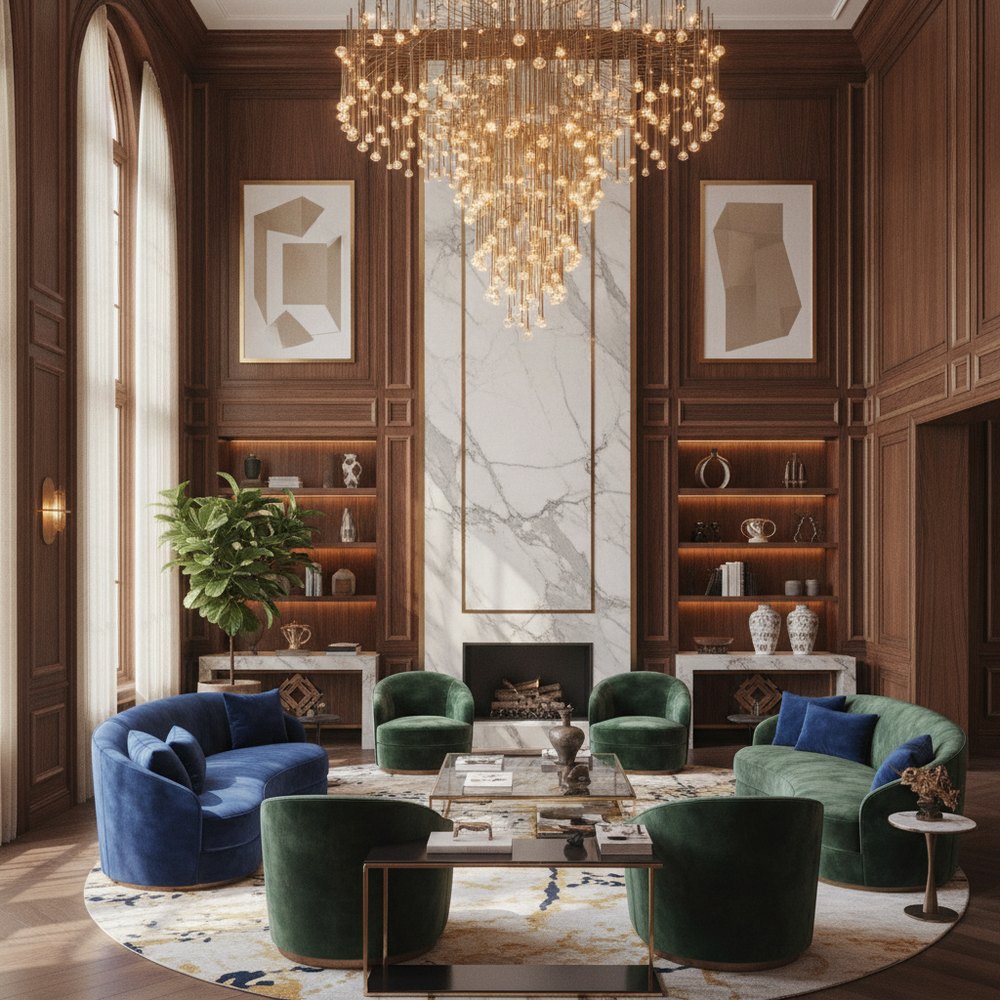
Indian traditional interior design in a modern home works best as a restrained palette of four elements: carved or turned timber, brass, one jaali or lattice screen, and a small number of deeply saturated colours. Use one strong traditional piece per room against calm modern surfaces, rather than filling a space with everything at once.
The difference between traditional and themed
The failure mode is easy to describe and easy to fall into: every surface carved, every wall a rich colour, every textile heavily embroidered, and the room ends up reading as a restaurant interior rather than a home.
What separates traditional from themed is editing. A genuinely traditional Indian home was not uniformly ornate; it had calm plastered walls, cool stone floors, and a small number of extremely well-made objects that carried the detail. The carving was concentrated in specific places, doors, screens, a swing, a chest, and the rest of the room was quiet by comparison.
That is the principle worth carrying into a modern interior: concentrate the craft, calm everything else.
The four elements that do the work
You do not need more than these to make a room read as Indian.
- Timber with craft in it. Carved, turned or joined, ideally teak, sheesham or mango. One substantial piece, a chest, a swing, a pair of doors, a low daybed, carries a whole room.
- Brass. Lighting, handles, a lamp, a tray. It warms a room instantly and sits beautifully against both timber and stone.
- A jaali or lattice screen. The single most characteristic element, and it does something functional too: it divides space without blocking light.
- Saturated colour, sparingly. Indigo, deep ochre, terracotta, emerald. One of these, on one surface or in the textiles, not four of them everywhere.
How do you combine it with a modern apartment?
The pairing that consistently works is calm modern shell, traditional content.
Keep the architecture plain: plastered or simply painted walls, a neutral floor, clean door and window details, no applied moulding. Then introduce the traditional pieces as objects within it. A carved chest against a limewashed wall looks extraordinary; the same chest in a room with carved everything disappears.
This is also the practical answer for renters and for people who like the look but are not sure they want to commit. The traditional layer is portable. The shell stays neutral.
The jaali screen, used well
Worth its own section because it is the element most likely to be misused.
A jaali works when it has a job: separating an entrance from a living area, screening a pooja niche, filtering light from a west-facing window, giving a balcony privacy without darkening the room. It stops working when it is applied to a wall as decoration, at which point it is wallpaper with a shadow.
Scale matters more than pattern. A full-height screen reads as architecture. A small panel reads as a souvenir. If you can only afford one carved element in a room, make it this one and make it big.
Colour and textiles
Indian design has a reputation for maximalist colour that is only half deserved, and the restrained half is easier to live with.
The approach that works in a contemporary home is a warm neutral base, lime-washed white, sand, or a soft clay, with saturated colour arriving through textiles: a pair of indigo cushions, a block-printed throw, a deep ochre rug. That way the intensity is present but adjustable, and it does not commit you at wall scale.
For textiles, favour hand-work over pattern volume. One handloom throw with visible weave does more than three printed cushions. Block print, ikat, kantha and handloom cotton all carry texture as well as pattern, which is what stops a room looking like it was ordered in one click.
Room by room
Where each element sits most naturally.
- Living room. One large timber piece, a jaali screen if there is a division to make, brass lighting, textiles for colour. Keep the seating modern and low.
- Dining. A solid timber table is the anchor. Brass pendant over it. Skip the carved chairs, which usually make the room feel formal.
- Bedroom. Restraint pays here. A carved headboard or a pair of bedside chests, warm light, and calm walls.
- Entrance. The best place for a statement: a carved door, a brass mirror, a bench, and a strong floor.
- Pooja space. The natural home for concentrated craft, covered in our pooja room design guide.
What to avoid
A short list that prevents most of the common mistakes.
Avoid matching sets of carved furniture, which is what pushes a room from traditional to showroom. Avoid using every colour at once; pick two. Avoid high-gloss finishes on traditional timber, which kills the depth that makes it worth having. Avoid mass-produced carving where the pattern is machine-repeated with no depth, since the whole appeal is that a person made it. And avoid treating it as a costume: if only the accessories are Indian and nothing structural in the room responds, it reads as decoration rather than design.
See it in your own home
This is a style where the difference between beautiful and overdone is a matter of quantity, which is exactly what is hard to judge in advance.
With Decorly you can photograph your room and test one strong traditional element against a calm modern shell, then compare it against a more heavily layered version, before buying anything. For related reading, see pooja room design ideas and maximalist interior design.
Frequently asked questions
How do I add Indian traditional design to a modern home?
Keep the shell calm, plain plastered walls, a neutral floor, no applied moulding, and introduce traditional pieces as objects within it. One substantial carved timber piece, brass lighting, a full-height jaali screen and saturated colour through textiles is usually enough for a whole room.
What is a jaali screen used for?
It divides space without blocking light, which is why it works for separating an entrance from a living area, screening a pooja niche, filtering harsh west light or giving a balcony privacy. It works far less well applied flat to a wall purely as decoration.
What colours are used in traditional Indian interiors?
Indigo, deep ochre, terracotta and emerald are the characteristic saturated colours, usually set against a warm neutral base of limewash, sand or soft clay. In a contemporary home it is easier to live with those colours in textiles rather than at wall scale.
How do I avoid an Indian-inspired room looking themed?
Concentrate the craft and calm everything else. Avoid matching sets of carved furniture, limit yourself to two saturated colours, choose hand-made over machine-repeated carving, and make sure something structural in the room responds rather than only the accessories.